
Introduction: The Cassette Tape Is Back
The cassette tape was supposed to be dead. Streaming was meant to have killed it decades ago. And yet here we are: in Q1 2025, UK cassette sales surged 204.7%, reaching over 63,000 units in a single quarter (source). The cassette player hardware market itself is projected to be worth $2.5 billion globally by 2030.
This isn’t nostalgia for nostalgia’s sake. Research suggests that 59% of 18–24 year olds now regularly consume music on physical formats. Gen Z — the generation that grew up on Spotify — is the primary demographic driving the cassette revival. For them, a cassette is something tangible, collectible, and cool in a way that a playlist link will never be.
For musicians, record labels, and creators, this represents a genuine opportunity. Cassette tapes are affordable to produce, lightweight to ship, visually striking, and increasingly expected as part of a physical media merch offering. They carry significant chart weighting in the UK, and at a gig merch table they’re an accessible impulse purchase at a lower price than vinyl.
This guide covers everything you need to know about cassette tape duplication in the UK: how the process works, the different recording methods, tape types, shell colours, packaging options, artwork preparation, and how to choose the right duplication partner for your project.
Table of Contents
What is Cassette Tape Duplication?
Cassette duplication is the process of recording audio onto blank cassette tapes from a digital master. Your audio files are loaded into specialist recording equipment, which writes the audio as a magnetic signal onto the ferric oxide tape inside each cassette shell.
The result is a professional-quality cassette tape that plays on any standard cassette player, Walkman, or boombox. Unlike the wobbly home-dubbed tapes of the 1990s, professionally duplicated cassettes are produced on calibrated equipment that delivers consistent levels, accurate stereo imaging, and clean playback across the entire tape.
Most UK duplication services work from digital audio files (WAV or AIFF), though some can also dub from a physical master tape or CD. The finished tapes are then printed with on-shell labels or direct printing, assembled into your chosen packaging, and shipped to your door.
Understanding Tape Types and Grades
The magnetic tape inside a cassette has a direct impact on audio quality. There are four internationally recognised tape types (though one – type III ferrichrome – was so short-lived that it is rarely mentioned), though only one is still manufactured today.
Type I — Ferric (Normal Bias)
Type I ferric tape is the standard cassette tape type and the only formulation still in active production worldwide. Modern high-quality ferric tapes have come a long way from the budget blanks of the 1980s. Today’s premium ferric formulations deliver a dynamic range of 57–60 dB, excellent bass response, and a warm, characterful sound that many artists and listeners actively prefer.
Ferric tape excels at reproducing bass-heavy music, with higher midrange output levels than many Type II tapes. It has a gentle roll-off at the frequency extremes rather than a sharp cliff, which contributes to the warm, analogue character that cassette enthusiasts love.
Type II — Chrome (High Bias)
Chrome tape offered superior high-frequency performance and was the preferred choice for music labels throughout the 1980s and 1990s. The chromium dioxide coating provided better treble response and lower tape noise than ferric. However, chrome tape is no longer in active production. Limited remaining stocks of vintage chrome tape (notably BASF Chrome Extra) are available at some specialist duplicators, but supplies are finite and dwindling.
Type IV — Metal
Metal particle tape was the highest-performing cassette formulation ever produced, offering the best frequency response and dynamic range. Like chrome, it is no longer manufactured. Surviving stock is rare and expensive.
What This Means in Practice
Today, all commercially duplicated cassettes use Type I ferric tape. This is not a compromise — modern ferric formulations are significantly better than the budget ferric tapes of decades past. The warm, slightly saturated character of ferric tape is part of the format’s appeal, and for the vast majority of music genres, it sounds excellent.
Tape Length Guide
Cassette tape lengths are measured in total playing time (both sides combined):
C10 = 5 min per side | C20 = 10 min per side | C30 = 15 min per side | C45 = 22.5 min per side | C60 = 30 min per side | C90 = 45 min per side.
Choose the shortest tape that fits your content. Excess blank tape at the end of each side means silence during playback, which can be underwhelming for the listener. Most duplication services can wind tapes to custom lengths to the nearest minute.
Cassette Shell Colours and Styles
One of the most exciting aspects of the cassette revival is the extraordinary range of shell colours now available. The days of plain black or white shells are long gone. Today’s cassette releases can be as visually striking as any vinyl pressing.
The Colour Palette
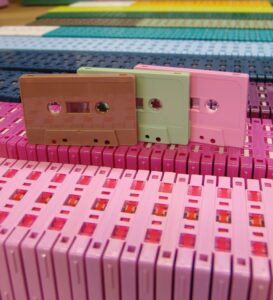 Leading UK duplication services such as Band CDs offer 80+ shell colours, spanning:
- Solid colours: Classic black, white, red, blue, green, yellow, orange, pink, purple, and dozens more.
- Transparent colours: Crystal clear, transparent red, blue, green, purple, orange, smoke, and more. These let the tape reels show through for a striking visual effect.
- Metallic and mirror finishes: Mirror silver, mirror gold, metallic red, metallic blue — eye-catching shells with a reflective sheen.
- Vintage and distressed finishes: Stressed bronze, stressed silver, and aged-look shells that evoke a retro aesthetic.
- Glow-in-the-dark: Shells that charge in light and glow in the dark — a novelty that works brilliantly for certain genres and aesthetics.
- Glitter and sparkle: Glitter-infused transparent shells that catch the light.
Choosing the Right Shell
Your shell colour is a creative decision that should complement your artwork, genre, and brand identity. A few considerations:
- Transparent shells look stunning but your on-shell label needs to work visually with the visible tape reels and hub underneath.
- Dark solid shells (black, navy, dark green) provide a classic, professional look and work well with light-coloured label printing.
- Bright and metallic shells stand out on merch tables and in social media photos — they’re Instagram-ready.
Matching your shell colour to your album artwork creates a cohesive, considered product that feels intentional and premium.
Top tip: Order a sample shell in your chosen colour before committing to a full run, especially if you’re planning to photograph the tapes for promotional use. Colours can look different on screen versus in hand.
On-Shell Printing and Labels
The cassette shell itself is a canvas for your branding. There are several approaches to getting your artwork, track listing, and credits onto the tape.
Printed Labels (Stickers)
The most common approach for short-run cassette duplication. High-resolution labels are printed on adhesive paper or vinyl and applied to both sides of the cassette shell. Labels can be full-colour (CMYK), giving you complete design freedom for artwork, photography, text, and logos.
Labels are cost-effective, look professional, and are the standard for independent releases. The main limitation is that they add a very slight thickness to the shell, which is imperceptible in practice.
Direct-to-Shell Printing (UV Printing)
UV printing applies ink directly onto the cassette shell surface using ultraviolet-cured inks. The result is a flush, seamless finish with no label edge — the artwork becomes part of the shell itself. UV printing works on both solid and transparent shells, though the visual effect differs: on solid shells the print sits on top; on transparent shells, it creates a layered effect with the tape visible behind the design.
Direct printing is typically more expensive than labels but produces a premium, retail-quality product.
Pad Printing
Pad printing transfers ink from an etched plate to the shell surface via a silicone pad. It’s commonly used for single-colour or two-colour designs (e.g., a logo and text). Pad printing is durable and cost-effective for simple designs but doesn’t support full-colour photographic artwork.
Blank (No Print)
Some releases intentionally leave the shell blank or minimally branded, relying on the packaging alone to carry the artwork. This can create a striking minimalist aesthetic, particularly with coloured or transparent shells.
Packaging Options
Cassette packaging has evolved far beyond the basic clear case. Today’s options range from classic Norelco boxes to boutique rave cases, each offering a different aesthetic and practical experience.
Norelco Cases with J-Cards
The Norelco case is the classic hard, clear plastic cassette case that everyone recognises. It’s the same style used to package cassettes commercially from the 1970s through the 1990s, and it remains the most popular choice today. Inside, a folded paper insert called a J-card provides space for your cover artwork, track listing, credits, and spine text.
J-cards are available in several configurations:
- Standard J-card (2-panel): Front panel, spine, and rear flap. The interior of the front panel can also be printed with additional artwork or lyrics.
- 3-panel J-card: Adds an extra fold-out panel inside the case, giving more space for liner notes, lyrics, or photography.
- 4-panel U-card: Two additional panels that roll-fold inside, providing even more space for design and content.
- 5-panel J-card: Maximum print area with three fold-out panels.
O-Cards (Cassingle Sleeves)
A cassette O-card is a printed card sleeve that wraps snugly around the cassette shell, open at both ends. The tape slides in and out of the sleeve. O-cards are a plastic-free, eco-friendly alternative to Norelco cases and have a clean, modern look. They’re typically shrink-wrapped after the tape is inserted to keep everything together.
O-cards are popular for cassette singles, limited editions, and releases where a minimalist, eco-conscious aesthetic is desired.
Obi Strips
Borrowed from Japanese vinyl and CD packaging, an obi strip is a narrow paper band (typically 20-30mm wide) that wraps around the spine of a Norelco case. Obi strips usually carry the title, barcode, catalogue number, or promotional text. They add a collectible, boutique feel to any cassette release and are increasingly popular in indie and underground music circles.
Rave Cases
Rave cases are clamshell-style plastic cases that hark back to the computer game cassettes of the 1980s (think Commodore 64 and ZX Spectrum). They have a rigid front and back that snap closed, with an outer clear pocket for a printed insert and space for a full wrap-around cover.
Available in single, double, triple, and quad configurations, cassettes in rave cases are perfect for multi-tape releases, box sets, or any project where you want a distinctive, retro-computing aesthetic. They’re available in black or white.
Packaging Comparison
| Packaging | Material | Print Area | Protection | Eco-Friendly | Best For |
|---|---|---|---|---|---|
| Norelco + J-card | Plastic case + card insert | Good (front, spine, rear, interior) | Excellent | Low | Standard releases, retail |
| Norelco + U-card | Plastic case + extended insert | Very good (4–5 panels) | Excellent | Low | Albums with lyrics/liner notes |
| O-card sleeve | Card only | Moderate (front, back, spine) | Basic | High | Singles, eco releases, minimalist |
| Rave case (single) | Plastic clamshell + card insert | Good (wrap-around + insert) | Excellent | Low | Retro aesthetic, gaming-inspired |
| Rave case (quad) | Plastic clamshell + card insert | Good | Excellent | Low | Multi-tape box sets |
| Norelco + obi strip | Plastic case + card + paper band | Good (J-card + obi) | Excellent | Low | Collector’s editions, Japanese aesthetic |
Preparing Your Audio for Cassette Duplication
Preparing audio for cassette is slightly different from preparing audio for CD or digital distribution. The analogue nature of the format requires some specific considerations.
File Format and Specifications
| Specification | Requirement |
|---|---|
| File format | WAV or AIFF (uncompressed, lossless) |
| Sample rate | 44,100 Hz (44.1 kHz) or higher |
| Bit depth | 16-bit minimum; 24-bit preferred for real-time duplication |
| Channels | Stereo (2-channel) |
| Delivery | Separate files for Side A and Side B, or individual tracks clearly labelled with side allocation |
Side Allocation
Unlike CDs, cassettes have two sides. You need to decide which tracks go on Side A and which on Side B. Aim for roughly equal running times on each side to avoid long stretches of blank tape. Many artists use Side A for the first half of the album and Side B for the second half, but you can arrange tracks however you like.
Consider the listening experience: the end of Side A and the beginning of Side B are natural pause points where the listener flips the tape. Some artists use this to create a deliberate dramatic break or shift in mood.
Mastering for Cassette
If your master was prepared for CD or streaming, it will work perfectly well on cassette without any additional processing. However, if you want to optimise specifically for the format, a dedicated cassette master can make a noticeable difference:
- Bass management: Excessive sub-bass energy (below 40 Hz) can cause the tape to saturate unevenly. A gentle high-pass filter at 30–35 Hz can help.
- High-frequency balance: Cassette tape naturally rolls off treble slightly, particularly on high-speed duplicated tapes. A subtle treble shelf boost (+1–2 dB above 8 kHz) in the master can compensate.
- Dynamic range: Cassette tape has a more limited dynamic range than digital formats. Heavily dynamic masters (e.g., classical recordings with extreme quiet-to-loud swings) may benefit from gentle compression for cassette.
- Level: Aim for an average level of around −6 to −3 dBFS with peaks no higher than −1 dBFS. This gives the tape enough signal without driving it into heavy saturation.
Do You Need a Separate Cassette Master?
For most pop, rock, electronic, and hip-hop releases: no. Your standard digital master will sound great on cassette.
For acoustic, classical, or very dynamic recordings, a dedicated cassette master from your mastering engineer is worth considering.
File Naming
Name your files clearly to avoid any confusion during production:
- Side_A_01_Track_Name.wav
- Side_A_02_Track_Name.wav
- Side_B_01_Track_Name.wav
- Side_B_02_Track_Name.wav
Alternatively, if you prefer to supply pre-assembled sides:
- Album_Name_Side_A.wav
- Album_Name_Side_B.wav
Preparing Your Artwork
Cassette artwork is produced at a smaller scale than CD or vinyl artwork, which means every detail needs to be sharp and legible.
General Requirements
- File format: High-resolution PDF (preferred), or TIFF/PSD at 300 dpi minimum
- Colour mode: CMYK (not RGB)
- Bleed: 3mm on all edges
- Safe zone: Keep text and logos at least 3mm inside the trim line
- Fonts: Convert all text to outlines
On-Shell Labels
Cassette shell labels are small — typically around 100mm x 63mm with rounded corners. At this size, readability is critical. Use a minimum font size of 6pt for body text and ensure there’s strong contrast between text and background. Avoid highly detailed photographic artwork at this scale; bold, graphic designs tend to work best.
Remember that the tape window (the clear section where the tape reels are visible) occupies the centre of most cassette shells. Your label design needs to account for this — artwork will have a cut-out or gap where the window sits.
J-Card Dimensions
J-card templates vary between suppliers, but typical dimensions for a standard 2-panel J-card are approximately:
- Total flat size: approximately 254mm x 102mm (including flap and spine)
- Front panel: approximately 102mm x 65mm
- Spine: approximately 102mm x 7mm
- Rear flap: approximately 102mm x 30mm
Always request the exact template from your duplication company before starting design work. Templates vary between suppliers and between packaging types. Designing to the wrong template will require costly rework.
Design Tips for Cassettes
- Bold, high-contrast designs reproduce best at cassette scale.
- Keep spine text short — the spine is only about 7mm wide.
- If using transparent shells, consider how the visible tape reels interact with your label artwork.
- Photograph your shell colour sample before finalising artwork to ensure colours complement each other.
- Include all legal text (copyright, catalogue number, barcode) on the J-card rather than the shell label where space is limited.
How to Choose a Cassette Duplication Service
The cassette revival has brought new players into the duplication market alongside established specialists. Here’s what to look for.
Shell Colour Range
If visual presentation matters to your release, look for a service with a wide range of shell colours. Some companies offer only black, white, and a handful of colours; others stock 80 or more options including transparent, metallic, glow-in-the-dark, and vintage finishes.
Minimum Order Quantity
Cassette duplication minimums vary widely. Some services require 50 or 100 units; others will produce as few as 20 or 25 tapes. If you’re testing the market or producing a limited edition, a low minimum is essential.
Packaging Options
Make sure your chosen service offers the packaging type you want. Not all duplicators offer rave cases, obi strips, or multi-panel J-cards. If you have a specific packaging vision, confirm availability before ordering.
Quality Control
Ask about the quality control process. Real-time duplication naturally allows for individual tape checking. For high-speed runs, ask what sample rate is used for QC and what happens if a defective tape is found.
Turnaround Time and Communication
Standard cassette duplication turnaround in the UK is typically 5–10 working days, depending on quantity and complexity. Express options may be available. Clear communication throughout the process — especially during artwork proofing — is a sign of a reliable service.
Questions to Ask a Cassette Duplication Service
- How many shell colours do you stock?
- What is your minimum order quantity?
- Do you offer obi strips, rave cases, and multi-panel J-cards?
- Can you wind tapes to a custom length?
- Do you provide artwork templates for your packaging?
- What is your quality control process?
Step-by-Step: From Audio Files to Finished Cassettes
- Plan your release. Decide on your track listing, side allocation, tape length, shell colour, packaging type, and quantity. If you’re uncertain, your duplication partner can advise.
- Prepare your audio. Supply WAV or AIFF files at 44.1 kHz/16-bit minimum, clearly labelled with side and track number. Confirm total running time per side.
- Design your artwork. Request templates from your duplication company. Design your shell labels, J-card (or other packaging insert), and any obi strip in CMYK at 300 dpi with 3mm bleed.
- Place your order. Submit your audio files, artwork files, and order details. Specify shell colour, tape length, packaging type, and quantity.
- Review proofs. Check digital proofs of your shell labels and packaging artwork carefully. Verify spelling, track order, colours, and layout.
- Once proofs are approved, your tapes are recorded, printed, assembled, and quality-checked. Standard turnaround is 5–10 working days.
- Receive and check. When your cassettes arrive, play-test at least two or three tapes from the batch on both sides. Check packaging assembly and print quality.
- Release and sell. Your cassettes are ready for gig merch tables, online stores, Bandcamp, record shops, and chart submissions.
The UK Cassette Market: Why Now?
The numbers tell a compelling story. Cassette tape sales in the UK finished 2025 at 164,000 units, up 53% year on year. ERA reported that revenue from ‘other physical formats’ (predominantly cassettes) grew 95% to £4.6 million. On the secondary market, some cassettes are selling for up to ten times their retail price.
Cassettes now carry meaningful weighting in the Official UK Charts. Several artists have used cassette-exclusive releases and variants to drive chart positions, and the format has become a genuine competitive tool for labels chasing a Number 1 album.
The audience is also shifting. Gen Z is the most active physical media demographic, with 59% of 18–24 year olds consuming music on physical formats. The format’s appeal to this audience is rooted in its tactile, collectible nature and its aesthetic potential — coloured shells, custom artwork, and limited-edition packaging make cassettes inherently shareable on social media.
The Business Case for Cassettes
- Lower production cost than vinyl (typically £3–£8 per unit depending on quantity and packaging).
- Higher margins than streaming: a cassette sold at a gig for £8 generates more than thousands of streams.
- Lightweight and compact: easy to carry to gigs and affordable to ship.
- Chart-eligible for the Official UK Charts with significant physical media weighting.
- Gen Z’s preferred physical format after vinyl: visually striking and highly shareable.
- Limited-edition potential: coloured shells, numbered runs, and exclusive packaging create scarcity and demand.
Complementary Formats: Building a Physical Media Strategy
Cassettes work brilliantly as part of a broader physical media offering. Consider pairing your cassette release with complementary formats to maximise your audience reach and revenue.
- CDs: Still generating over £125 million annually in the UK. CDs offer longer running times, higher audio fidelity, and are the industry standard for press packs and radio submissions.
- Vinyl CDs: CDs manufactured with vinyl-effect grooves that look like miniature records. A unique collector’s item that bridges the gap between CD and vinyl aesthetics.
- MiniDiscs: A niche but growing collector’s format. If you’re in alternative, electronic, or experimental music, MiniDisc releases can attract dedicated fans.
- USB drives: Custom USB drives (shaped like cassettes, floppy disks, or vinyl records) can deliver high-resolution audio, bonus content, and videos in a physical package.
- NFC tag stickers: Attach to any physical product. Fans tap with their phone to link directly to a Spotify page, music video, or exclusive content.
Frequently Asked Questions
How many cassettes should I order?
Start with 25–50 if it’s your first cassette release. Cassettes are increasingly collectible, and limited runs often sell out quickly. You can always re-order. Many artists find that 50 tapes is enough for an initial gig run, while 100–200 covers online sales and distribution.
Can I supply MP3 files?
You can, but you’ll be compromising the quality of your cassettes. MP3 is a lossy format that discards audio data to shrink file size. When that compressed audio is then recorded onto analogue tape, you’re stacking two layers of quality reduction. Always supply uncompressed WAV or AIFF files for the best results.
What cassette length should I choose?
Choose the shortest standard tape length that fits your content, rounding up to the nearest available length. If your album is 32 minutes total (16 minutes per side), a C35 or C40 is ideal. Avoid C90 tapes for a 30-minute album — the long stretches of blank tape at the end of each side create an unsatisfying listening experience. Most duplication services can wind tapes to custom lengths.
Do cassettes qualify for the UK charts?
Yes. Cassettes sold through qualifying retailers are eligible for the Official UK Albums Chart and Singles Chart, provided they meet the Official Charts Company’s eligibility rules. Cassettes have become an increasingly important format for chart positioning.
What about Dolby noise reduction?
Dolby B and Dolby C noise reduction systems were common in the cassette era, but most modern cassette releases are produced without Dolby encoding. Most modern consumer cassette players lack Dolby decoding, and playing a Dolby-encoded tape without a decoder results in an unnaturally bright sound. Unless you have a specific reason to use it, skip Dolby.
Can I sell cassettes on Bandcamp?
Absolutely. Bandcamp is one of the most popular platforms for selling physical music formats, including cassettes. You can list cassettes as a physical product with a set price, link them to the digital album for instant streaming, and ship directly to fans. Bandcamp takes a smaller cut than most retail channels and your audience is already there.
Conclusion
The cassette tape is more than a nostalgic novelty — it’s a vibrant, growing format with real commercial value and cultural relevance. For musicians and labels, cassettes offer an affordable, visually striking, and chart-eligible physical product that resonates with audiences of all ages, but particularly with the Gen Z demographic that’s driving the revival.
With dozens of shell colours, multiple packaging options, and professional real-time duplication ensuring excellent audio quality, there has never been a better time to release your music on cassette. The format rewards creativity in presentation, encourages limited-edition thinking, and creates a tangible connection between artist and fan that no streaming platform can replicate.
About Band CDs
Band CDs is a specialist cassette, CD, vinyl CD, MiniDisc, and VHS duplication company based in Lee-on-the-Solent, Hampshire. We offer over 80 cassette shell colours, real-time duplication as standard, and packaging options including Norelco cases, rave cases, O-cards, and obi strips. With over 8,500 musicians served and clients including Universal Music, Sony Music, and the BBC, we’re one of the UK’s leading physical media producers. Orders start from just 25 units.
Get a quote: www.bandcds.co.uk/place-order | Call us: +44 (0) 1489 872988 | Email: [email protected]
Posted on Google